History of Ayurveda
Ayurveda is an ancient medicine system of the Indian subcontinent. It is said to have originated in India about 5000 years back and is practiced to attain complete health in the four pursuits of human life (Dharma, Artha, Kama and Moksha). Moksha (salvation) is considered to be the ultimate goal of a man.
The word Ayurveda is composed of the Sanskrit words ‘AYU’, meaning 'life' and ‘VEDA’, meaning 'science', thus Ayurveda literally means the 'science of life’. The main concept of Ayurveda is that it personalizes the healing process.
Ayurveda is known as Upaveda in the Atharvaveda. For the welfare of humans, Brahma, the Creator, memorized the science of Ayurveda and taught it to Daksha Prajapathi, Ashwini Kumar and Indra. Then it was taught to the eminent sages, Bharadwaja, Dhanwanthari, Kashyapa, Nimi and a few others. And in this way the life science descended to Earth, was refined and established as Ashtangaayurveda.
 The eight branches of ayurveda are as follows:
- Kaya Chikitsa – General Medicine.
- Bala Roga Chikitsa – Pediatrics.
- Graha Chikitsa – Psychiatry.
- Urdwanga Chikitsa – E.N.T & Ophthalmology.
- Shalya Chikitsa – Surgery.
- Visha Chikitsa – Toxicology.
- Rasayana Chikitsa – Rejuvenation Therapy.
- Vajeekarana Chikitsa – Aphrodisiacs.
Ayurveda is not only a curative therapy but also a preventive one. It is designed to prevent and protect against diseases.
The Prakruti and Purusha are both similar to the living body "Shatdhatwatmaka purusha" (Panchamaha Bhootha and Aatma).
The equilibrium of Dosha (tri dosha), dhathu (saptha dhathu), and mala (tri mala) form the integral cause of human body. Human body has no existence without these principles and pleasantness of Aatma manaha and indriya is known as 'Swasthya' (physical and mental wellbeing or health).
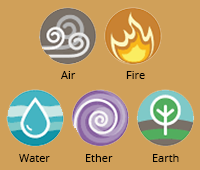
Panchamaha Bhootha
Tridosha
(Functional Units of the Body)


Vata
(Air & Ether)
This is the only dosha which can move by itself and make other doshas moving. It is considered as king among doshas. All the activities or movements like circulation, heart beating, elimination, binking of eyes etc. can be done because of Vata. Balancing and imbalancing of this dosha will be quicker while comparing with other doshas. It is seen that a person with vata prakriti has a dry and rough skin, will be lightly built, will be quick in their mental process and initiation of action.

Pitha
(Fire & water)
Pitta manages all heat, metabolism and transformation in the mind and body. Digestion, metabolism & transformation in body etc. are done as a result of Pitta. It is seen that pitta prakriti individuals tend to sweat a lot and tend to have a higher than normal body temperature.

Kapha
(Water & Earth)
Kapha is unctuous, smooth, soft, and sweet in taste, stable, dense, slow, rigid, cold and clear. Kapham manages the immune system. It is seen that the Kapha prakriti individuals tend to have soft limbs, slow gait and are slow to understand. The cold quality means that their agni or digestive power is low.